
Palestinian Prisoner’s Society: Occupation continues to escalate crime of “administrative detention”
September 8, 2025
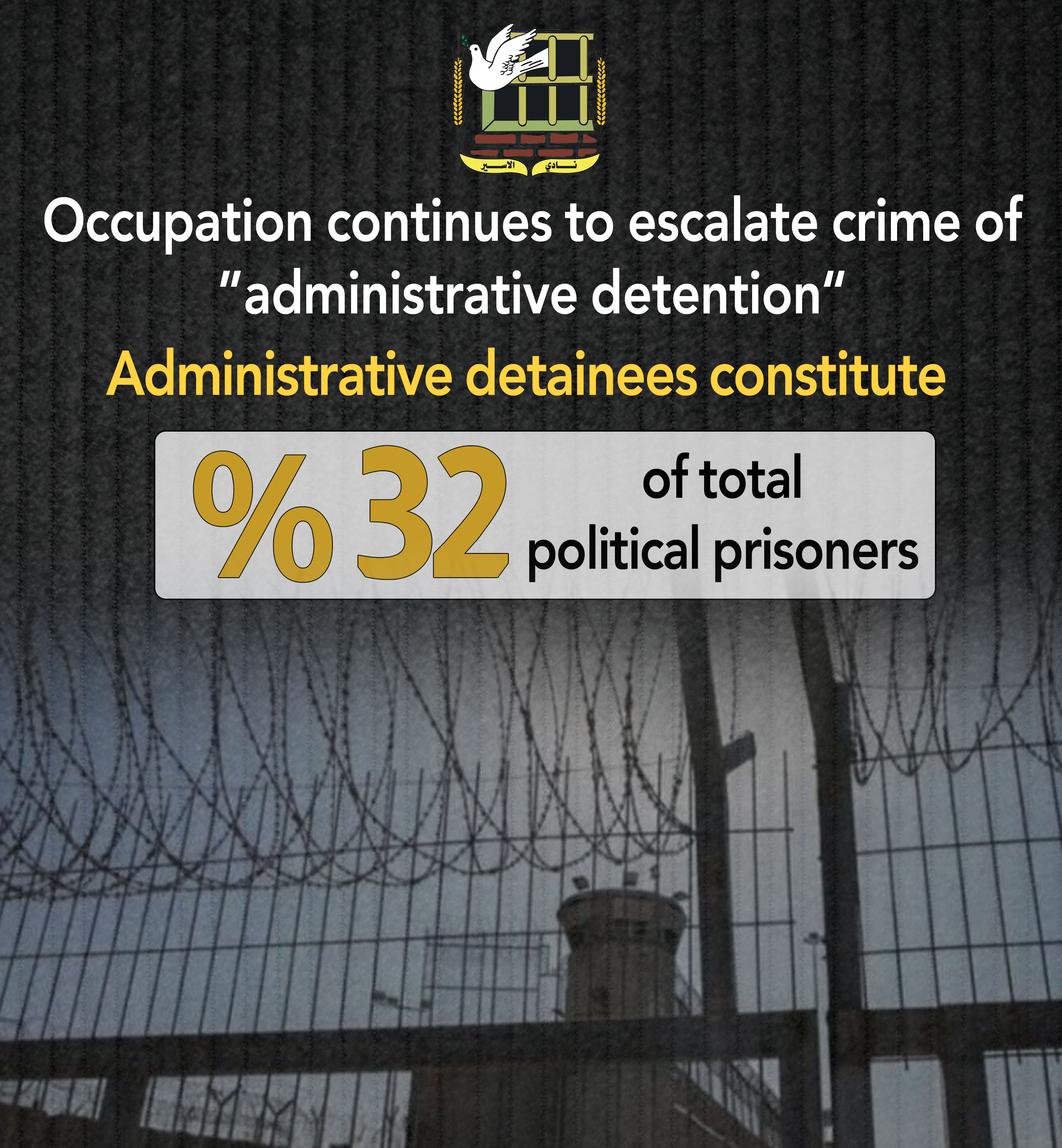
Palestinian Prisoner’s Society: Occupation continues to escalate crime of “administrative detention”
- Administrative detainees constitute 32% of total political prisoners
- Journalists Ali al-Samoudi, Moath Amarneh, and Usayd Amarneh are an example of the occupation's targeting of journalists through “administrative detention”
September 8, 2025
Ramallah, occupied Palestine - The Palestinian Prisoner’s Society stated that occupation authorities continue their unprecedented escalation in the use of the “administrative detention” policy, or holding people without trial or charge, which, since the beginning of the genocide in Gaza, has constituted one of the most prominent tools that have brought about a significant shift in the number of detainees inside occupation prisons. This percentage is now higher than that of those undergoing military trials, convicts, and those classified as "illegal combatants.” They represent 32% of the total number of political prisoners in Israeli occupation jails.
The PPS added that over the past two weeks, the occupation has re-arrested dozens of people administratively, including former prisoners who had previously served long terms in administrative detention and were released only a few months ago. The PPS emphasized that the occupation's military courts continue to play a role in enforcing the policy of “administrative detention,” through their decisions, which are based entirely on orders from the occupation's intelligence services, and through sham trials that reflect the true purpose for which these courts were established.
The PPS noted that one of the groups the occupation continues to target through “administrative detention” is journalists. The occupation recently re-arrested journalists Moath Amarneh and Usayd Amarneh from Bethlehem and placed them under administrative detention without trial or charge. The occupation's intelligence services issued a four-month detention order for Moath and six-month detention orders for Usayd, both of whom are former prisoners. The occupation's intelligence services also renewed the administrative detention of journalist Ali al-Samoudi from Jenin for an additional four months, making him one of 54 journalists still detained by the occupation, including 21 held in “administrative detention”.
In this context, the PPS quotes journalist Ali al-Samoudi, during a lawyers’ visit to the Naqab prison, as saying that he suffers from deteriorating health and harsh detention conditions, like all other prisoners. Al-Samoudi explained that since his transfer to the Naqab several months ago, he has been wearing the same clothes and that he fell during the prisoners' exit to the prison yard, causing a head injury. He indicated that he was subjected to abuse and assault during his arrest and transfer from Megiddo Prison to the Naqab Prison, where his glasses were broken. He also suffers from the effects of an old injury dating back to when he was injured with shrapnel during the martyrdom of journalist Shireen Abu Akleh, in addition to other health problems.
Journalist Moath Amarneh, who was previously arrested during the genocide and released months ago, suffers from several health problems, including diabetes. He also suffers from the effects of an injury he sustained in 2019 by Israeli occupation forces while performing his journalistic duties. He lost one eye, with the bullet still lodged in his brain.
The PPS emphasized that detained journalists in occupation prisons and camps face all forms of abuse to which prisoners are generally subjected, including systematic torture, severe beatings, starvation, and medical crimes, in addition to ongoing policies of humiliation and abuse, denial of basic rights, and detention in harsh and degrading conditions.
The continued targeting of journalists is an extension of the systematic assassinations in Gaza, as part of the ongoing war of extermination. This is an ongoing attempt to assassinate the voice of truth and target the Palestinian narrative that contributed to exposing the crimes and atrocities committed by the occupation during its genocide.
Data:
• The total number of Palestinian political detainees in occupation prisons is more than 11,100 people, as of the beginning of September 2025.
• The number of “administrative detainees” is 3,577 people, including children and women.
Journalists:
• Since the beginning of the genocide, 197 cases of arrest among journalists have been recorded.
• 54 journalists remain behind bars, including 49 who were arrested during the genocide, and 5 others who were arrested before it.