
🔴 Release Does Not End the Crime: Bodies of Released Palestinian Political Prisoners Reveal Ongoing Extermination In Occupation’s Detention
January 26, 2026
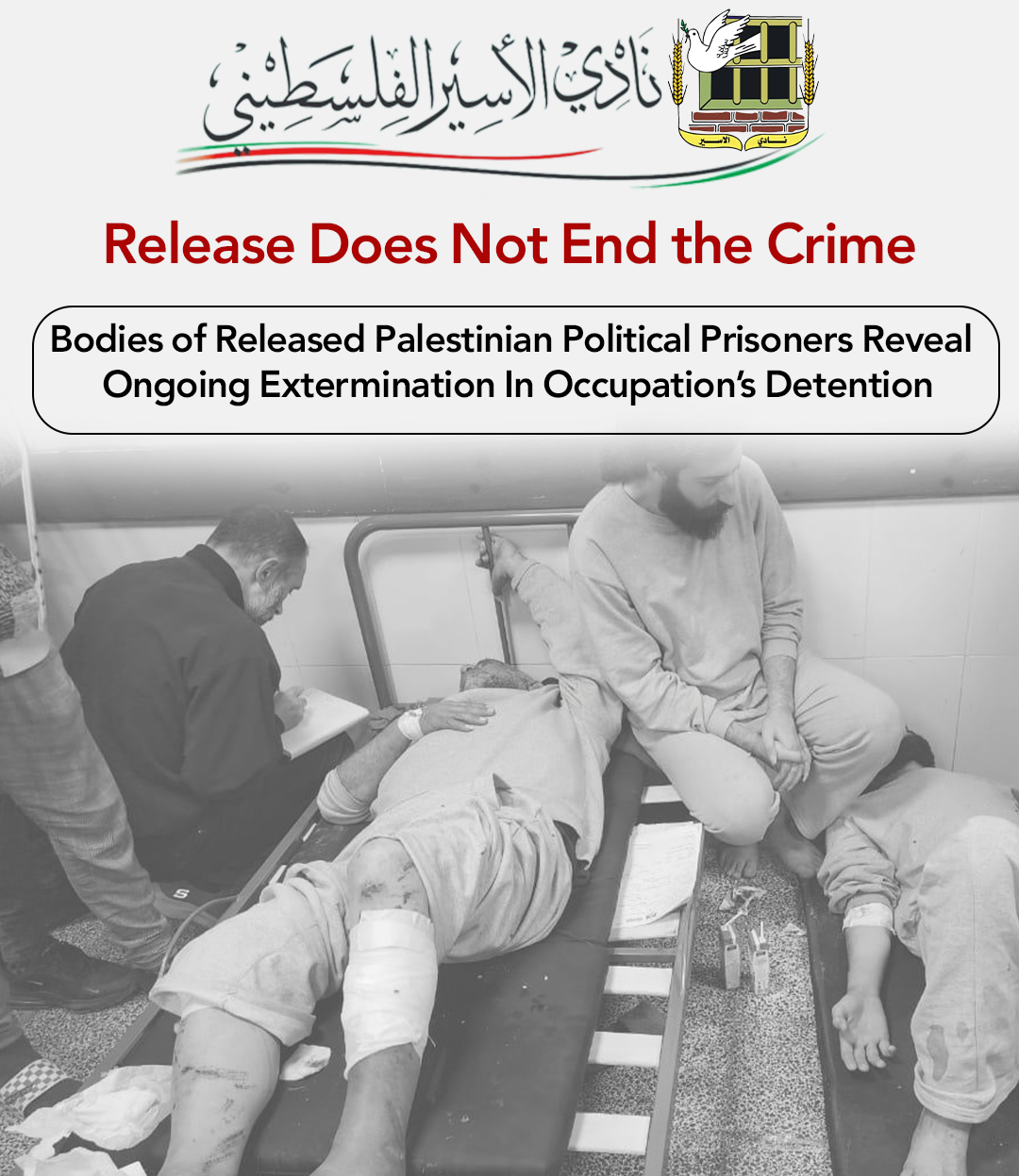
🔴 Release Does Not End the Crime: Bodies of Released Palestinian Political Prisoners Reveal Ongoing Extermination In Occupation’s Detention
Palestinian Prisoner's Society
January 26, 2026
Ramallah, occupied Palestine — The Palestinian Prisoner’s Society (PPS) stated that the release of Palestinian political prisoners from the Israeli occupation’s custody does not mean that the crimes against them have ended. In fact, many released prisoners are being transferred directly to hospital upon their release. Their testimonies, physical appearance, and severe deterioration in health—both physical and psychological—stand as living evidence of the ongoing reality of extermination practiced against prisoners and detainees inside the Israeli occupation’s prisons. These conditions reflect more than two years of systematic crimes and policies entrenched by the prison apparatus, which have transformed prisons into fully integrated torture arenas in every sense of the word.
The PPS added that all released prisoners suffer from health and psychological problems to varying degrees. A number of them were released in grave and complex medical conditions that required hospitalization and urgent surgical interventions. Among the most prominent recent cases is that of journalist Mujahid Muflih. He was held under administrative detention without trial or charge for approximately seven months. Three days after his release, he suffered a cerebral hemorrhage and underwent emergency brain surgery. To this day, he remains in critical condition in the intensive care unit at Al-Istishari Hospital in Ramallah in the central occupied West Bank.
In addition to Muflih’s case, administrative detainee Khaled al-Saifi was released yesterday from the so-called “Ramla Prison Clinic” in extremely serious medical condition. He is unable to walk, suffers from severe pulmonary fibrosis, and requires intensive medical care. It is worth noting that this was his second arrest during the Gaza genocide, and on both occasions he was transferred to hospital in critical condition as a result of what he endured during his detention.
The PPS further confirmed that it has documented numerous cases of released prisoners suffering from severe bruising and fractures due to brutal beatings inflicted during release, necessitating their immediate transfer to hospitals. A large number of prisoners were also released while infected with scabies skin disease, requiring medical isolation and treatment.
These escalating cases reveal the magnitude of the humanitarian catastrophe faced by prisoners and their families, and the level of systematic physical and psychological destruction practiced by the Israeli occupation’s prison system in an unprecedented manner since the onset of the genocide and up to the present day. These crimes have taken on an increasingly severe trajectory over time against thousands of prisoners held under coercive, degrading, and inhumane conditions—within policies aimed at breaking willpower, branding consciousness, imposing deterrence, and ultimately leading to the slow execution of prisoners, as has occurred at an unprecedented rate since the start of the genocide.
The PPS also noted that these grave developments coincide with the accelerating efforts of the occupation to pass legislation authorizing the execution of prisoners, alongside a special legal framework to prosecute Palestinian detainees abducted from Gaza that likewise includes the “penalty” of execution—thereby laying a legal foundation for further grave violations and organized crimes.
The systematic paralysis afflicting the international community in the face of the occupation’s crimes and the crime of genocide has directly enabled Israel to continue implementing its criminal policies against the Palestinian people and political prisoners across multiple arenas, using various levels and tools—most dangerously within the prison system.
In closing, the PPS renewed its repeated demands to allow the International Committee of the Red Cross (ICRC) to visit prisoners, assess their conditions and circumstances of detention, and enable families to visit their detained relatives. It also called on the international human rights system to persist in serious efforts to hold occupation leaders accountable for their crimes and to impose deterrent sanctions that would put an end to Israel’s unchecked brutality—now posing a threat to universal human and humanitarian values.