
Palestinian Child’s Day Highlights Escalating, Systematic Targeting of Palestinian Children
April 5, 2026
Palestinian Child’s Day Highlights Escalating, Systematic Targeting of Palestinian Children
Report by the Commission of Detainees’ Affairs, Addameer Prisoner Support and Human Rights Association, and the Palestinian Prisoner’s Society
April 5, 2026
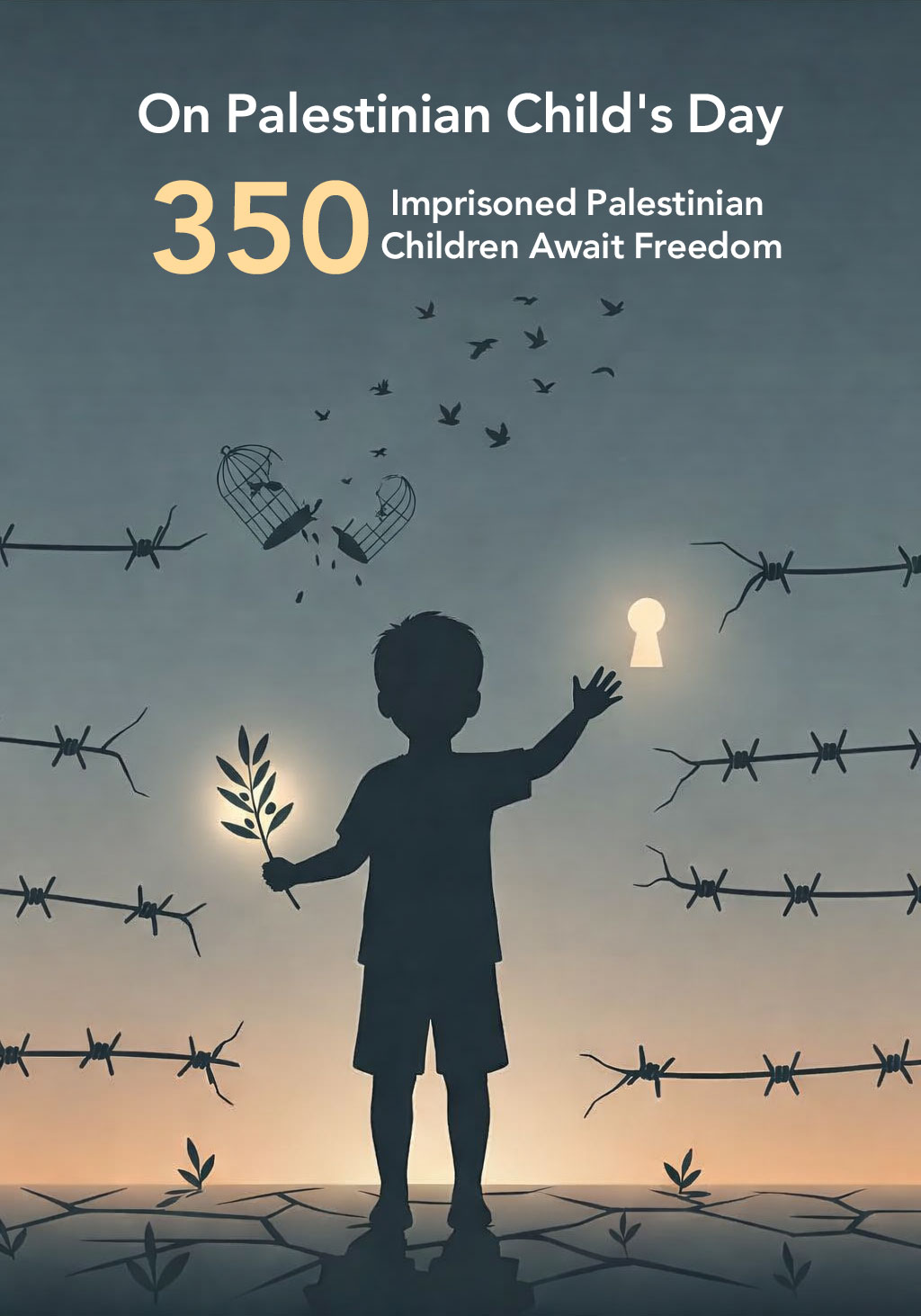
Ramallah, occupied Palestine - Palestinian childhood has never been outside the scope of Israeli occupation policies; it has been at their core. The detention of children is not exceptional or incidental, but a longstanding, systematic policy—deeply embedded over decades—reflecting a clear intent to subjugate and control an entire generation through organized repression and domination. As of April 2026, there are 350 Palestinian children detained in the occupation’s prisons.
Tens of thousands of Palestinian children have experienced detention—staggering figures that expose the scale and continuity of this practice. Their testimonies point to a comprehensive system of violations, carried out under legal cover and enforced with excessive violence, in disregard of age and of international child rights conventions.
Since the outbreak of the genocide in Gaza in October 2023, occupation authorities have intensified widespread arrest campaigns across the occupied Palestinian territories. These campaigns continue to escalate, targeting all segments of Palestinian society—across cities, villages, and refugee camps—in the West Bank, including Jerusalem, as well as in the Gaza Strip. They unfold within a broader pattern of daily, terrorizing military raids and incursions into homes, streets, and military checkpoints, without distinction by age or social group, reflecting a comprehensive policy of control and sustained repression.
Within this context, the targeting of children stands out as one of the clearest manifestations. Palestinian childhood has entered a more acute phase of direct targeting, where detention remains a systematic, deliberate tool of pressure and control—not an exception, but an enduring policy.
Field data issued by Palestinian prisoners’ organizations and human rights institutions have revealed an unprecedented escalation in the arrest of children. More than ---- cases of child detention have been documented in the West Bank, including Jerusalem, over a short period of time—an indication of the expanding scope and accelerating pace of this targeting.
In addition, dozens of children from the occupied Gaza Strip have been detained during the genocide, under extremely dangerous conditions that included grave violations and organized crimes, such as enforced disappearance, denial of family and lawyers’ visits, and the complete cut off of any means of communication with the outside world—making it extremely difficult to determine the actual numbers or the fate of many of them.
These practices constitute a clear and direct violation of the Convention on the Rights of the Child, which prohibits the arbitrary detention of children and requires that detention be used only as a measure of last resort and for the shortest possible period, while ensuring humane treatment and respect for dignity. They also clearly violate Article 37, which prohibits torture and cruel or inhuman treatment, and guarantees the child’s right to maintain contact with their family and to access legal assistance. Moreover, these practices breach the principles of international humanitarian law, particularly the Geneva Conventions, which mandate special protection for children as civilians and prohibit any form of abuse or neglect against them.
The First Moments of Arrest
The first moment of arrest often begins with a violent and sudden attack, usually in the early pre-dawn hours, when occupation forces break into homes without any prior warning. Families wake to the sounds of explosions and doors blown open, accompanied by heavily-armed, often masked, soldiers, shouting and raiding every corner of the house, creating an atmosphere of fear and chaos—especially for children facing such a harsh experience. Children are forced awake from their sleep amid direct threats and a heavy military presence.
During the raid, the child and their family are informed of the arrest decision. In many cases, children—particularly those who are ill or injured—are denied access to their medication or necessary medical care, further exacerbating their health conditions.
Following this, children are taken out of their homes into military vehicles, where they are handcuffed and subjected to strict restraints on their movement. During transport—often involving passage through multiple checkpoints and military facilities—some are subjected to beatings or harsh treatment, in addition to being held for long hours without food or water.
In many cases, children are transferred while blindfolded, deepening their sense of fear and confusion and leaving severe psychological effects from the very first moments of detention. Cases of enforced disappearance of children from the occupied Gaza Strip have also been documented, amid a lack of any information regarding their whereabouts or conditions of detention.
Interrogation Rooms Under Genocide: A Systematic Policy of Retaliation Against Childhood
The interrogation phase is one of the harshest stages in the experience of child detention within occupation prisons, as it is conducted in an environment designed to break their will and extract confessions from them as part of a systematic and consistent policy. Children are held in conditions that lack even the most basic necessities of life and are subjected to prolonged hours of continuous interrogation without the presence of their parents or a lawyer. Testimonies indicate that this stage is often exploited to psychologically intimidate the child and pressure them into confessing under the weight of isolation and fear.
The severity of these violations has escalated dangerously in the context of the genocide, as children have been subjected to even more tragic conditions inside closed and harsh interrogation rooms, where deprivation of sleep and rest is intensified.
These practices reinforce a reality that completely disregards the specific needs of the child and their right to humane treatment, turning interrogation into a repressive tool that extends beyond pre-genocide practices, but under far more brutal and unrestrained conditions.
Thus, the interrogation period—supposed to be a legal procedure—turns into a space of systematic violations aimed at undermining the rights of the child. This policy, which has intensified under the genocide, leaves deep and lasting impacts on children’s lives and futures as a result of continuous pressure and a detention environment that lacks the most basic human rights.
Palestinian Children in Occupation Prisons Face Systematic Violations
Inside Israeli central prisons and military camps, Palestinian children face harsh detention conditions that constitute a systematic violation of their fundamental rights. These conditions include severe overcrowding in poorly ventilated rooms, shortages of clothing and blankets, as well as near-total restrictions on their movement and the confiscation of their personal belongings.
For over two and a half years, children have been completely denied contact with their families, further deepening their isolation and intensifying the psychological impact of detention, amid ongoing raids and repression within the prison sections.
Violations linked to denial of medical care are also escalating amid a severe lack of health services and the denial of appropriate treatment for children. Overcrowding and the lack of hygiene supplies have led to the spread of skin diseases, most notably scabies, while medical responses are often limited to providing inadequate painkillers or delaying treatment, along with the refusal to transfer serious cases to hospitals.
Children also suffer from food deprivation as part of a policy of starvation, which has negatively affected their health and led to the worsening or emergence of new illnesses, within detention conditions that threaten both their physical and psychological well-being.
Detention Without Charge: Enforced Disappearance of Children Behind the Cells of Administrative Detention
Administrative detention of Palestinian children is considered one of the most egregious manifestations of the repressive system, whereby a child – like adults - is held without charge or trial, based on what is referred to as a “secret file.” This policy, long adopted by the occupation as a tool of collective punishment, repression, and control, has undergone a profound shift and historic escalation in the context of the genocide, as prison doors have been opened to thousands of Palestinians under this designation—children among them bearing a significant share of this systematic abuse.
Within this expansion, the number of children held under administrative detention has reached unprecedented levels. Palestinian human rights organizations have never previously recorded such figures, with approximately ---- children currently held under administrative detention—reflecting a clear intent to disappear an entire generation behind bars without any legal justification or defined timeline for release.
A child held under administrative detention lives in a state of continuous psychological torment, facing uncertainty every minute of every day. Detention orders are often renewed at the very last moment before the expected release, depriving both the child and their family of any sense of stability or hope. In the context of the genocide, the number of administrative detainees has surged dramatically, accompanied by total isolation and denial of visits or communication with the outside world—leaving children especially vulnerable to policies of starvation, abuse, and intimidation within the cells.
The targeting of children through administrative detention at this scale confirms that the occupation is in clear violation of all international conventions prohibiting the detention of minors without trial. With the total number of administrative detainees in prisons reaching ( ), it becomes evident that this policy has become a central pillar within the genocide—aimed at dismantling the Palestinian social fabric and targeting childhood itself.
Walid Ahmad: The Palestinian Child Who Starved to Death
Walid Khaled Ahmad, from the town of Silwad near Ramallah in the central occupied West Bank, was a detained Palestinian child who starved to death in Megiddo Prison in March 2025.
His case constitutes a stark example of inhumane and dangerous policies of starvation, deprivation, and ill-treatment against minor detainees, within a broader context of violations affecting prisoners. According to documented medical autopsy reports, the findings revealed severe physical deterioration, including extreme emaciation, and the absence of muscle mass and subcutaneous fat, along with indicators of malnutrition, dehydration, intestinal infections, and infection with scabies—reflecting a gradual health collapse inside detention.
The occupation recently announced the closure of the investigation into the circumstances of his murder under the pretext of “exhausting all legal procedures,” despite the serious findings outlined in the medical reports of starvation and health deterioration. This reflects a continued pattern of disregarding medical evidence and obscuring accountability for crimes committed against child detainees within prisons, in the complete absence of oversight and accountability for such violations.
Testimonies of Children from Inside Occupation Prisons
Child (Q.N.), who was arrested from his home on January 7, 2026, recounts that he was severely beaten before being handcuffed, blindfolded, and transferred to a military camp, then to Megiddo Prison. He reports repeated assaults both during transport and inside the prison.
He confirms that the minors’ section in prison is subjected to frequent raids and beatings, amid severe cold, overcrowding, and a shortage of clothing and insufficient food. They also face restrictions on outdoor time (“fora”) and access to showers, along with a lack of basic supplies and constant disturbing lighting. He further points to the absence of adequate care and the existence of designated rooms for scabies patients under harsh detention conditions.
In the same context, child (M.S.), who was arrested from his home in Bethlehem on February 19, 2025, at the age of just 15, was later placed under arbitrary administrative detention without trial or charge. He recounts that his arrest began at dawn with a home raid, after which he was transferred to Etzion detention center, then to Al-Moskobiya detention center in occupied Jerusalem, where he underwent a 21-day period of detention and interrogation before being transferred to Megiddo Prison.
Since then, he has been held in an overcrowded minors’ section (Section 8), with six to 10 prisoners per room, forcing some to sleep on the floor. There is a clear shortage of blankets, towels, and basic necessities, in addition to a very short daily outdoor period that does not exceed half an hour, with limited facilities including a small number of bathrooms shared among several rooms.
He also suffers from dental pain without receiving treatment, pain relief, or referral to a clinic, amid repeated raids and acts of repression within the section—making the conditions of detention in Megiddo harsh and ongoing, particularly as he is a child held under administrative detention.
Similarly, the detained child (A.K.), aged 17, describes a harsh detention trajectory from the moment of arrest, extending from checkpoints to detention centers and then to closed facilities.
He states: “I was completely stripped of my clothes, handcuffed, blindfolded, and thrown onto the ground,” adding, “I remained sitting on my knees for hours and was subjected to continuous severe beatings.”
He describes this phase as filled with humiliation and both physical and psychological violence, with repeated transfers between unknown detention locations and extremely harsh conditions from the very first hours.
Later, he recounts the brutal detention system inside the prisons, describing his first days: “I was handcuffed to the front and blindfolded 24 hours a day, even while eating and showering,” along with “very poor food in extremely small quantities” and repeated deprivation of hygiene and rest. He also describes weekly repressive raids involving “firing bombs inside the rooms, random beatings, and forcing prisoners to lie on the ground,” in addition to harsh interrogations that included “beatings, threats, electric shocks, and loud music as psychological torture,” within an environment he describes as based on continuous humiliation and systematic violence throughout detention.
Children from the occupied Gaza Strip have not been spared from widespread arrest campaigns during the genocide. Several were detained and transferred to military detention facilities. Among these testimonies is that of child (F.Sh.), born in 2010, who was a school student prior to his arrest.
He recounts being arrested in Khan Younis alongside four others, stating: “They arrested me with four people, and I was the only child among them. Then they handed us over to the army, which transferred us to Sde Teiman camp.” He adds that he was placed in barracks with adult detainees and another child, describing life there as “pure humiliation,” noting that he remained for approximately 40 days “handcuffed in front with iron restraints, without blindfolds.”
He describes daily life inside the camp, stating that “food is scarce and water is scarce,” with meals consisting of “sliced toast bread with a small amount of jam or tuna that does not satisfy hunger.” Sleeping conditions were extremely harsh: “You sleep on a very thin mattress, as if you are lying on stones,” while blankets were only provided at night despite severe daytime cold. Showering was permitted “twice a day for only a few minutes.”
He further recounts that raids and repression occurred “about once a week,” during which detainees were forced to the ground, restrained tightly, and beaten. He states that he was interrogated twice, each session lasting about an hour, noting: “There was no special treatment for me—they treated me like the adults.” He remained in Sde Teiman until his eventual release.
With the continuation of grave violations against Palestinian children in places of detention, coinciding with Palestinian Child’s Day, our organizations affirm that the arbitrary detention of children, the harsh conditions of confinement, and degrading treatment constitute a flagrant violation of international law—particularly the Convention on the Rights of the Child—and amount to war crimes and crimes against humanity.
We stress that our primary demand is the immediate and unconditional release of all detained Palestinian children, as their detention in itself constitutes an unlawful violation. We further call on third states to take urgent action to compel the occupying power to halt all violations against children, ensure their protection, and respect and implement the advisory opinion issued by the International Court of Justice regarding the illegality of the occupation, in addition to enforcing accountability for all crimes committed against Palestinian children.
*********