
United Against Execution and Extermination
April 16, 2026
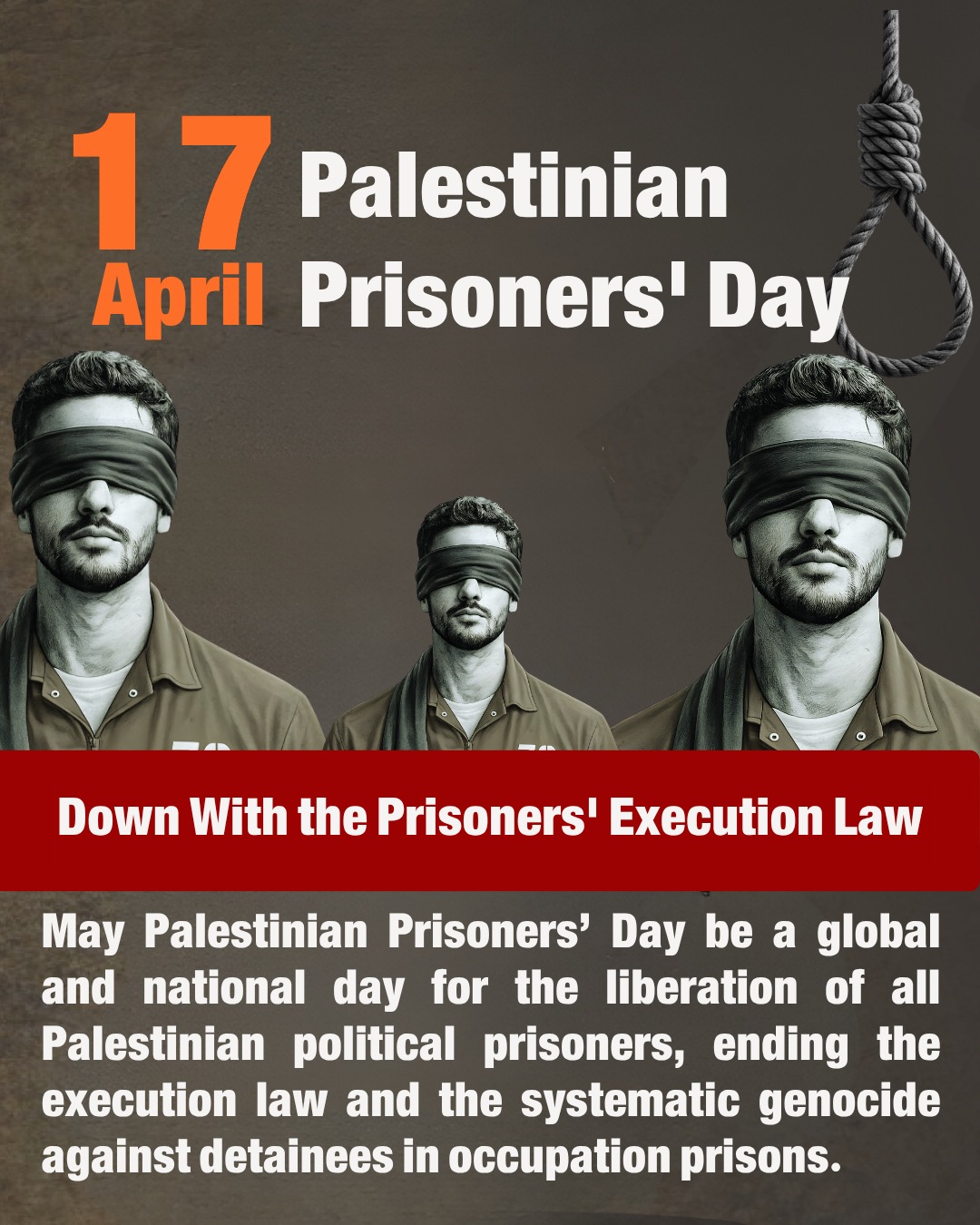
Palestinian Prisoners’ Day 2026
United Against Execution and Extermination
Report by the Palestinian Prisoner’s Society, Commission of Detainees’ Affairs and Addameer Prisoner Support and Human Rights Assocation.
April 16, 2026
Palestinian Prisoners’ Day 2026 comes at a time when Palestinian political detainees face the harshest levels of torture, abuse, and extermination in the history of the Israeli occupation. It comes at a time when the occupation’s parliament voted in favor of a horrific law to execute Palestinian prisoners – to make their murder legal. This law is inseparable from the structure of extermination, and an extension of policies of ethnic erasure, against the Palestinian people.
Over nearly three years, specialized human rights institutions have accumulated a substantial body of testimonies and evidence revealing the severe and widespread crimes committed against thousands of Palestinian prisoners. They occur within a structured system of repression based on torture, starvation, denial of medical care, and multiple forms of physical and sexual abuse, including rape. The data and experiences of prisoners reveals that the occupation’s prisons and military camps are no longer merely places of detention but have become spaces where policies of extermination are practiced – exposing another face of the crime of genocide that began in occupied Gaza.
Even before the passing of the ‘execution law,’ more than 100 Palestinian political prisoners had been murdered behind bars since the genocide in Gaza – through torture, severe physical assault, starvation and other inhumane methods. Meanwhile, dozens of detainees who were abducted from Gaza and were killed in custody, remain forcibly disappeared.
There are currently more than 9,600 Palestinian and Arab prisoners held in Israeli occupation prisons. Repression is intensifying, and systematic abuses are rapidly escalating. What prisoners face is no longer just an extension of occupation policies. In the wake of the genocide in Gaza, it has become part of a broader system of severe violence targeting Palestinian existence in all its forms.
In this context, prisoners’ institutions—including the Commission of Detainees’ Affairs, the Palestinian Prisoner’s Society, and Addameer Prisoner Support and Human Rights Association, along with partner organizations—stress that this moment demands more than symbolic solidarity. It is an urgent call to people and nations worldwide to take real action to stop the ongoing extermination of Palestinians, including prisoners, and to work to abolish the execution law, under the slogan: “United Against Extermination and Execution.”
On the eve of Palestinian Prisoners’ Day, held annually on April 17, this paper presents key facts and figures on the situation of Palestinian and Arab prisoners in Israeli occupation prisons and military camps. It draws on specialized human rights documentation, reports, and studies that shed light on the crime of extermination committed against them.
Key Data on Palestinian Political Prisoners (as of early April 2026):
· The total number of Palestinian and Arab political prisoners held in Israeli occupation prisons has exceeded 9,600 people, reflecting an 83% increase compared to pre-genocide figures (5,250 people).
· About 50% of all Palestinian political prisoners are held without trial or charge.
Females:
There are currently 86 female prisoners, including two minors (under 18), and two women detained prior to the genocide. Among them, 25 women are held under “administrative detention” without trial or charge.
Children:
Approximately 350 minors are detained, primarily in Ofer and Megiddo prisons. By the end of 2025, 180 children had been held under “administrative detention.”
“Administrative detainees”:
· This refers to Palestinians arrested from the occupied West Bank and are held without trial or charge under a military order.
· The number has risen dramatically to more than 3,532 detainees, including women and children.
· Most are former prisoners, alongside students, journalists, lawyers, engineers, doctors, academics, parliamentarians, activists, workers, and relatives of prisoners or martyrs.
· This marks a 168% increase (or about 2.7-fold higher) from the approximately 1,320 people held under this military order before the genocide began.
“Unlawful combatants”:
· This refers to Palestinians arrested from the occupied Gaza Strip and are held without trial or charge under the “Unlawful Combatants Law”.
· According to prison authorities, there are 1,251 Palestinians held under this category (excluding those held in military camps).
Sick prisoners:
The number has increased significantly. The vast majority suffer from illness—either pre-existing conditions, or injuries by occupation forces, or diseases developed due to the unsanitary and harsh detention conditions, torture, and denial of medical care.
Identified Martyred Prisoners:
Since the occupation of 1967, 326 Palestinians have been martyred inside the prison system, including 89 people since the genocide in Gaza began. This figure includes only those who have been identified. Dozens from Gaza remain forcibly disappeared.
Withheld bodies:
Occupation authorities are withholding the bodies of 97 martyred Palestinian prisoners marking an increase of over 781% (about 8.8-fold higher) compared to the period prior to the genocide when eleven martyred prisoners’ bodies were being withheld.
Prisoners Held Since Before Oslo Accords:
· Following the prisoner exchange deals—most recently in October 2025—and the release of prisoner Ibrahim Abu Mukh after 40 years in detention, eight Palestinians detained from before the Oslo Accords remain behind bars.
· The longest-held among them are Ibrahim Bayadsa and Ahmad Abu Jaber, both detained since 1986.
· Dozens of Palestinians are held from the period of the Al-Aqsa (Second) Intifada, and who have spent more than 21 years in occupation prisons. This group includes a number of military leaders, most of whom are serving life sentences.
· Following the exchange deals, 118 Palestinians are currently serving life sentences.
· The longest sentences include:
o Abdullah Barghouti (67 life sentences)
o Ibrahim Hamed (54 life sentences)
Mass Arrests in the West Bank Since Start of Genocide in Gaza:
Occupation forces have carried out more than 23,000 arrests in the West Bank and Jerusalem since the start of the genocide in Gaza.
· This figure does not represent the current number of detainees – it includes those still detained and those later released.
· It covers every individual subjected to arrest, whether through organized military raids on homes, at military checkpoints, those forced to surrender under pressure, or those detained as “hostages” to pressure a family member to surrender themselves.
· The figures do not include the estimated thousands of arrests carried out by occupation forces in the Gaza Strip, noting that many detainees from Gaza remain subject to enforced disappearance.
The 23,00 arrests figure includes:
- Over 700 arrests among women.
- Some 1,800 arrests among children.
- More than 240 arrests among journalists, with 43 still detained, including three female journalists. One journalist, Marwan Harzallah from Nablus, was martyred in prison.
These arrest campaigns have been accompanied by escalating violations, including severe beatings of family members including children, deliberate and extensive destruction and vandalism of homes, terrorizing raids and threats against detainees and their families, theft of belongings, personal items, cash and gold, and extensive damage to infrastructure—especially in the Tulkarem and Jenin refugee camps.
Additionally, occupation forces have carried out countless field executions, including against family members of detainees, and intensified field interrogations affecting thousands across the West Bank and Gaza.
Key Demands:
· Activating the principle of universal jurisdiction to prosecute those involved in acts of torture, war crimes, and crimes against humanity committed against prisoners.
· Suspending all forms of diplomatic, military, economic, and academic cooperation with the occupation until it fully complies with international law.
· Halting engagement with the occupation’s Knesset and courts as racist institutions, and working to isolate them internationally, including rejecting their membership in international parliaments and unions.
· Ensuring the immediate and unconditional release of all Palestinian political prisoners, including ending the policy of administrative detention and dismantling the military court system.
· Fully cooperating with the International Criminal Court, supporting its investigations, and enforcing arrest warrants against those responsible for international crimes.
· Enabling the International Committee of the Red Cross to visit prisoners and monitor their detention conditions without restrictions.
United Against Execution and Extermination
#EndTheExecutionLaw
#FreeThemAll
For more information, visit:
· Commission of Detainees Affairs: https://www.cda.gov.ps/index.php/ar/
· Palestinian Prisoners’ Club: https://www.ppsmo.ps/
· Addameer: https://addameer.ps/ar
للاطلاع على الملف اضغط هنا