
From Nakba to Genocide: 78th Commemoration of the Palestinian Nakba
May 15, 2026
May 15, 2026
From Nakba to Genocide: 78th Commemoration of the Palestinian Nakba
More than 23,000 arrests by Israeli occupation forces in West Bank since start of Gaza genocide; thousands of other detainees from occupied Gaza
Palestinian political prisoners face most violent period in history of Israeli occupation and Palestinian struggle for freedom
Palestinian Prisoner’s Society
Ramallah, occupied Palestine — On the 78th anniversary of the ongoing Palestinian Nakba, the Palestinian Prisoner’s Society (PPS) said in a statement on Friday that the crime of imprisonment has long been — and continues to be — one of the fundamental pillars of the Israeli settler-colonial project, as a systematic tool targeting the Palestinian presence and dismantling the social and national fabric of the Palestinian people. This has been carried out through policies of repression, isolation, abuse, torture, and enforced disappearance, all of which have escalated at an unprecedented rate since the start of the genocide against our people in the occupied Gaza Strip.
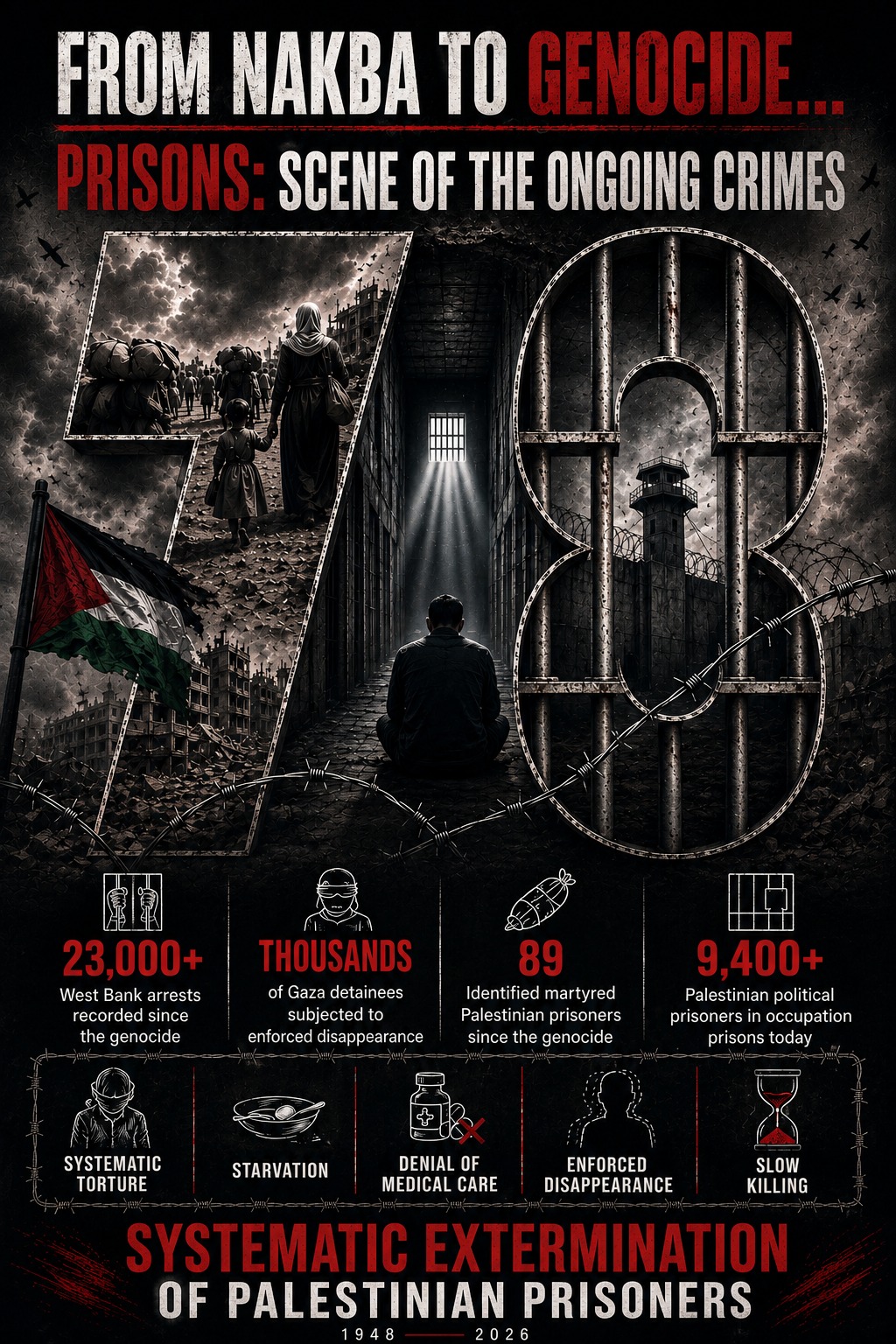
Occupation authorities have arrested at least 23,000 Palestinians from across the occupied West Bank and occupied Jerusalem since the start of the genocide in October 2023, including women, children, wounded individuals, and formerly released prisoners, the Palestinian Prisoner’s Society said. This figure does not include the thousands of arrests carried out in the occupied Gaza Strip, amid the continued practice of enforced disappearance against large numbers of Palestinians abducted from the Gaza Strip, while the occupation refuses to disclose their fate, places of detention, or health and humanitarian conditions.
The transformations imposed by the genocide have not been limited to the expansion of mass arbitrary arrest campaigns alone, but have also affected the nature of crimes committed. The occupation’s prison system has been transformed into organized spaces for torture, starvation, humiliation, and systematic denial of medical treatment, in an attempt to attack the human and national identity of prisoners and break their collective and individual will.
The PPS stressed that the current phase is the bloodiest and most violent in the history of the Palestinian prisoners’ movement, amid escalating crimes including executions, slow killings, torture, sexual assaults, starvation, and medical neglect and denial. This has led to the killing of over 100 Palestinian prisoners since the start of the genocide, including 89 whose identities alone have been revealed by the Israeli occupation’s prison services. These are individuals who were killed through direct torture, starvation, or deliberate medical crimes. This raises the number of identified martyred Palestinian prisoners since the occupation of 1967 to 326 people. Meanwhile, the occupation continues to forcibly disappear the bodies of dozens of martyred detainees from Gaza.
What Palestinian prisoners – both males and females - are facing today cannot be separated from the long history of the ongoing Palestinian Nakba. The policy of mass imprisonment has, since before the Nakba, formed part of the colonial tools of control that began during the British occupation through emergency laws, military courts, and exceptional regulations. These were later inherited and further developed by the Israeli occupation into one of its most widely used methods for subjugating Palestinians.
The PPS stated that the Israeli regime has arrested more than one million Palestinians over decades of occupation, in an ongoing effort to target Palestinian collective consciousness and undermine the social, political, and national structure of Palestinian society. Yet despite all attempts at isolation and repression, the prisoners’ movement succeeded in transforming prisons into arenas of resistance, organization, and national consciousness, establishing a long struggle that became an essential part of the history of the Palestinian national movement.
Through decades of confrontation, Palestinian prisoners developed advanced methods of struggle behind bars, most notably the open-ended hunger strike, which became a central symbol in the battle to defend human dignity and basic rights in the face of a colonial system that continuously sought to strip them of their humanity.
The PPS emphasized that the occupation’s targeting of Palestinian political leaders, its attempts to dismantle the organizational structure inside prisons, and its imposition of a reality of organized terror against male and female prisoners will not succeed in breaking their will or erasing their national role. Prisoners continue to represent a central symbol of the Palestinian struggle and an enduring banner of the battle for freedom and dignity.
In this context, the Palestinian Prisoner’s Society pointed out that the occupation continues to detain more than 9,400 Palestinians in its prisons, including 86 female prisoners and 3,376 “administrative detainees” – those arrested from the occupied West Bank and are held without trial or charge , in addition to 1,283 detainees classified by the occupation authorities as “unlawful combatants,” – those arrested from Gaza and are held without trial or charge - within the framework of an exceptional legal system used to institutionalize arbitrary detention and enforced disappearance against Palestinians.