
Mid-Year Fact-Sheet 2026
July 28, 2026
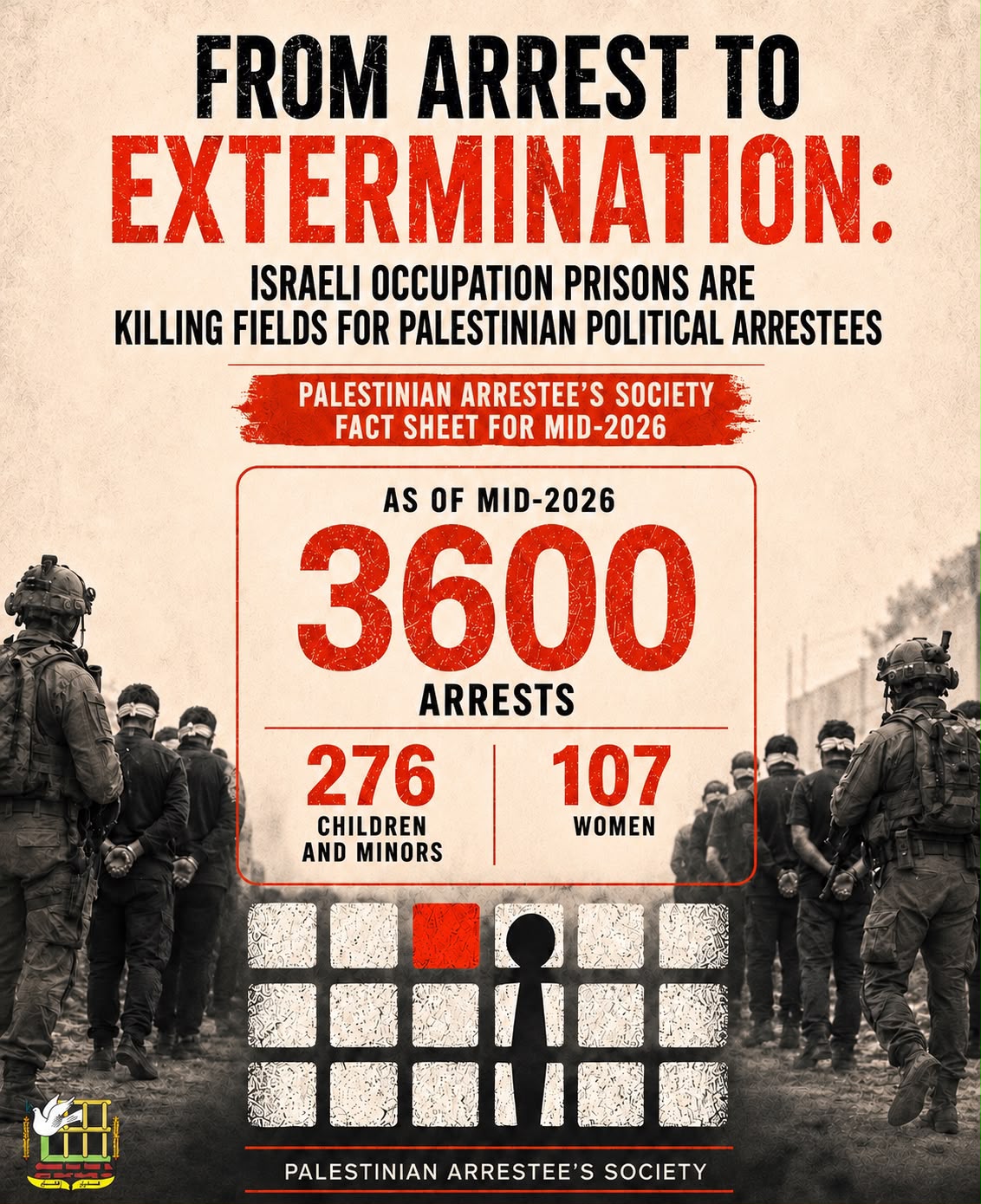
Mid-Year Fact-Sheet 2026
Palestinian Prisoner’s Society (PPS)
July 28, 2026
Introduction
Since the onset of the genocide in the Gaza Strip in October 2023, the Israeli occupation’s prison infrastructure, together with the broader apparatus of political arrest and imprisonment of Palestinians, has undergone a profound structural transformation. The rates of abduction and incarceration of Palestinians have surged to unprecedented levels, with the policies and practices of this machinery having moved beyond colonial methods of suppressing Palestinian freedom. It has now become an integral component of the occupation’s genocidal actions and intentions against all Palestinians, from the river to the sea, with particularly egregious manifestations in the occupied Gaza Strip and the West Bank, including Jerusalem. This apparatus is meticulously designed to destroy Palestinians—both individually and collectively, physically and psychologically.
Detention no longer aims solely to deprive Palestinians of their freedom but targets their very existence through an integrated system of structural torture, physical assault, starvation, denial of medical care and deliberate medical neglect, the spread of diseases and epidemics, sexual assault, deprivation of food, leading ultimately to both direct and indirect murder.
These developments represent not only an escalation in prison conditions but also the institutionalisation of policies intended to facilitate prolonged suffering and death in custody. The continued spread of preventable diseases, combined with systematic medical neglect and other forms of abuse, has contributed to the severe deterioration of the health of thousands of Palestinian prisoners and detainees.
Violations are no longer isolated practices or transgressions committed by individuals; they have become state policy, managed through the prison and military camp system, and based on legislation, procedures, and decisions from the top political echelons, aimed at transforming detention into a central tool of genocide. These policies have led to the murder and death of over 100 Palestinian political prisoners since the start of the genocide alone, with the identities of only 90 of them revealed by occcupation authorities, many of them years after their date of martyrdom.
The Israeli occupation also continues to withhold information regarding the fate and whereabouts of dozens of martyrs from the Gaza Strip, while also retaining the bodies of dozens of martyrs from of Palestinian political prisoner. These practices constitute an ongoing extension of the crime of enforced disappearance, and the crimes of denying families the right to know the fate of their loved ones, to recover their remains and grant them a dignified burial in accordance with international law.
Such policies have been continuously documented over years not only through the testimonies of current and former prisoners whom legal teams have been able to visit, and reports issued by Palestinian prisoner institutions and human rights organizations, but also through statements by top Israeli officials who openly speak of their acts and intentions against Palestinian political prisoners.
In this paper, the Palestinian Prisoner’s Society presents the tally of documented arrests by Israeli occupation forces in the West Bank and Jerusalem in 2026 so far, along with latest figures and a breakdown of political prisoners and detainees held in the Israeli regime’s central prisons and military camps. The PPS also reviews the most prominent crimes and policies of the occupying state’s prison system during this period, as part of the genocidal acts against Palestinian political prisoners amid the ongoing genocide in the Gaza Strip.
The data presented here represents only the minimum that could be documented, given the occupation's continued imposition of enforced disappearance on thousands of detainees from the Gaza Strip and its prevention of human rights institutions and the International Committee of the Red Cross from accessing them. This makes the scale of crimes committed within prisons and military camps far greater than what the figures and facts presented in this paper reveal.
Key Figures by Mid-2026
· More than 3,600 Palestinians arrested in the occupied West Bank and Jerusalem.
· Hundreds more arrested in the occupied Gaza Strip, although the exact number remains unverified due to the ongoing genocide and the inability to comprehensively document arrests.
· 276 children arrested.
· 107 women arrested.
· Approximately 900 arrests recorded in March 2026, the highest monthly total during the stated period including 73 children and 22 women.
· More than 700 arrests recorded in Hebron governorate, the highest number of any governorate in the occupied West Bank.
Political Prisoner Figures as of Early July 2026
According to Palestinian prisoners' institutions and data released by the “Israeli Prison Service” as of early July 2026:
· Approximately 9,400 Palestinian prisoners and detainees are currently being held in Israeli occupation prisons.
· 99 are women.
· More than 350 are children, held primarily in Megiddo and Ofer prisons.
· 3,244 from the occupied West Bank and Jerusalem held under “administrative detention” without charge or trial.
· 1,320 detainees from Gaza classified held under the "unlawful combatants", also without trial or charge. This figure does not include all detainees from Gaza held in Israeli military camps under the same classification and also includes Arab detainees from Lebanon and Syria.
Arrest Figures Since Gaza Genocide
· More than 24,600 arrests recorded in the occupied West Bank and Jerusalem, since the start of the genocide.
o This figure does not include arrests from the Gaza Strip, which are estimated to number in the thousands due to ongoing obstacles to documentation, including enforced disappearance, incommunicado detention, and systematic abuses.
· More than 785 women have been arrested and detained since the beginning of the genocide.
· More than 1,900 children have been arrested in the occupied West Bank during the same period.
Main Systematic Crimes Documented Against Palestinian Political Prisoners:
· Systematic torture and widespread physical and psychological abuse, including beatings, humiliation, threats, and degrading treatment.
· Deliberate starvation and deprivation of adequate food, resulting in severe physical deterioration among detainees.
· Medical neglect and denial of healthcare, including the withholding of treatment and practices described as medical crimes.
· The spread of diseases, particularly scabies (Sarcoptes scabiei), due to the denial of medical care, inadequate hygiene conditions, and the refusal to take effective measures to contain outbreaks.
· Sexual violence and abuse, including strip searches, sexual harassment, sexual assaults, degrading treatment, and attacks targeting prisoners’ bodies.
· Collective punishment, including confiscation of personal belongings, deprivation of basic necessities, restrictions on fundamental rights, and punitive measures imposed on groups of prisoners.
· Comprehensive isolation of prisoners, used as a tool of punishment, coercion, and psychological pressure.
· Excessive use of force, including the use of rubber-coated bullets inside detention facilities, particularly targeting prisoners’ limbs and sensitive areas, resulting in injuries requiring medical intervention in some cases.
· A system of killing detainees through conditions of detention, including starvation, medical neglect, torture, and prolonged deprivation.
· Prevention of contact between prisoners and their families, including blanket ban on family visits and communication since the Gaza genocide began.
· Enforced disappearance and denial of information regarding detainees’ conditions and whereabouts.
· Expansion of discriminatory legislation, including laws providing for the death penalty against Palestinian political prisoners.
Mass Arbitrary Arrests, Interrogations, and Abuse
During this period, large-scale arrest campaigns were accompanied by extensive field interrogations carried out by occupation forces. These interrogations involved crimes and abuses comparable in severity to those committed inside interrogation and detention centres.
Thousands of Palestinians, particularly following the beginning of the ongoing genocide, were subjected to systematic field detention and interrogation procedures involving torture, abuse, and various forms of assault. These practices targeted all segments of Palestinian society, including women, children, and the elderly.
The escalation of settler-colonial attacks across various governorates also contributed to the increase in arrests and field interrogations, particularly in villages and towns located near colonies built on Palestinian land or adjacent to them.
The arrest campaigns also involved the targeting of specific groups of Palestinians, including:
· The continued detention of Palestinian workers under the pretext of “illegal entry.”
· The use of hostage-taking policies, whereby individuals are detained as a means of pressuring family members to surrender.
· The expansion of arbitrary detention practices against civilians without adequate legal safeguards.
Mass Arbitrary Use of “Administrative Detention” and the “Unlawful Combatants Law”
The occupation authorities have continued to expand the use of “administrative detention” and the “Unlawful Combatants Law” as mechanisms of control, punishment, and indefinite detention.
“Administrative detention”, or detention without charge or trial, has been used extensively and arbitrarily against Palestinians in the occupied West Bank and Jerusalem. Detention orders are issued and repeatedly renewed on the basis of so-called “secret evidence” that neither detainees nor their lawyers can view or challenge. Many detainees subjected to this policy are former prisoners who have spent years in occupation prisons and have repeatedly experienced successive periods of administrative detention.
The “Unlawful Combatants Law” has primarily been applied to Palestinians abducted from the occupied Gaza Strip and functions in a similar way to “administrative detention”. Since October 2023, Israeli occupation authorities have used this law extensively to detain Palestinians from Gaza, enabling prolonged incommunicado detention, restricted access to legal counsel, and the continued detention of individuals arbitrarily.
Sexual Violence and Physical Abuse
During this period, testimonies documenting sexual violence against prisoners increased significantly compared with previous years.
Documented forms of abuse include:
· Strip searches conducted in degrading and humiliating conditions.
· Sexual harassment and sexual assaults.
· The use of beatings, insults, and humiliation as methods of degradation and punishment.
· Attacks targeting prisoners’ bodies, including the use of rubber-coated bullets against sensitive areas.
There has also been a significant increase in the use of rubber-coated bullets inside detention facilities, particularly against prisoners’ limbs. These attacks have resulted in injuries of varying severity, including cases involving severe bleeding and the need for surgical intervention, demonstrating the continued use of excessive force as a tool of punishment and retaliation.
Medical Abuse and Deliberate Neglect
Medical abuse has become one of the most prominent forms of systematic violations against detainees. Beyond the denial of healthcare, detainees have been subjected to a broader pattern of medical neglect, including delayed or denied access to specialist treatment, the withholding of essential medications, inadequate treatment for chronic illnesses and injuries, and the failure to provide timely emergency medical care.
The spread of scabies (Sarcoptes scabiei) throughout prisons and military camps is one of the clearest manifestations of these policies and has been exacerbated by:
· The denial of adequate and timely medical treatment.
· The withholding of hygiene supplies and clean clothing.
· Severe overcrowding and unsanitary detention conditions.
· The refusal of prison administrations to isolate infected detainees or implement measures to contain outbreaks.
· The broader policy of systematic medical neglect affecting detainees.
In addition to scabies, detainees have suffered from untreated infectious diseases, malnutrition, significant weight loss, deteriorating chronic health conditions, untreated injuries resulting from torture and ill-treatment, and the long-term physical and psychological consequences of prolonged denial of healthcare.
These conditions have contributed to the severe deterioration of detainees' physical and mental health and, in a growing number of cases, have resulted in permanent disabilities and preventable deaths.
(ENDS)