
Palestinian Prisoners’ Institutions Hold Israeli Occupation Fully Responsible For Fate Of Female Journalist Bushra Al-Tawil – Held Without Trial Or Charge, In Solitary Confinement For Past Month
September 20, 2026
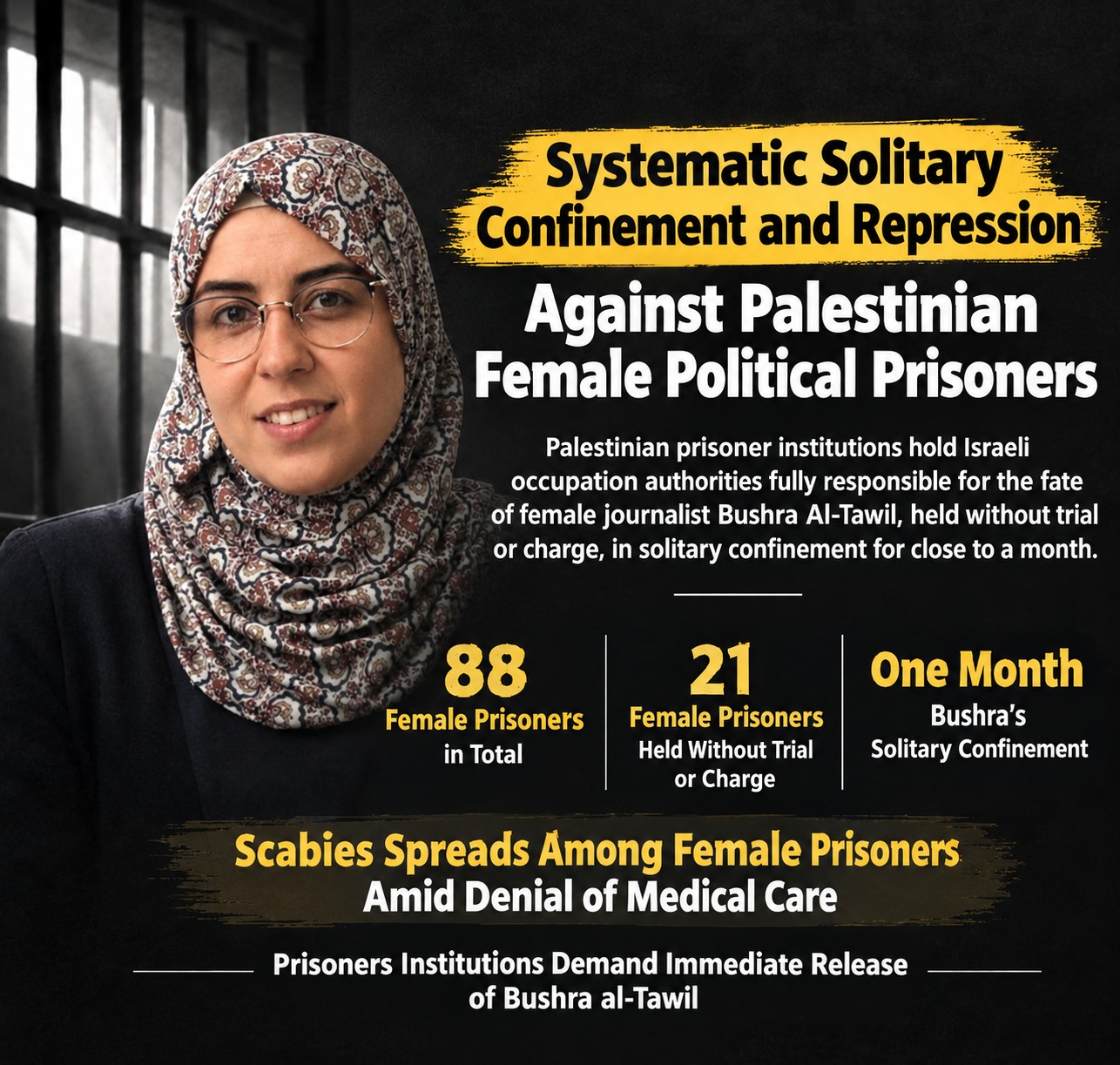
Palestinian Prisoners’ Institutions Hold Israeli Occupation Fully Responsible For Fate Of Female Journalist Bushra Al-Tawil – Held Without Trial Or Charge, In Solitary Confinement For Past Month
Prison Authorities Intensify Systematic Isolation of Palestinian Female Prisoners as Scabies Disease Spreads Amid Denial Of Medical Care
September 20, 2026
Ramallah, occupied Palestine –The Palestinian Prisoner's Society and other prisoner institutions in occupied Palestine hold Israeli occupation authorities fully responsible for the fate of administrative detainee Bushra Al-Tawil (33), a female journalist from the city of Al-Bireh near Ramallah in the central occupied West Bank. Al-Tawil has been held in solitary confinement for about a month in both "Neve Tirtza” and “Damon” prisons.
In a joint statement issued on Sunday, Palestinian prisoner institutions warned that al-Tawil's case embodies a broader trajectory of escalation against female prisoners, combining systematic and arbitrary solitary confinement, acts of repression, medical crimes, and the outbreak of diseases, which have transformed into a tool of torture. They demanded the immediate release of prisoner al-Tawil and the end of her solitary confinement.
The institutions explained that al-Tawil has been held in administrative detention (without trial or charge), since February 2026, and that she is one of the most targeted female prisoners who have faced administrative detention in recent years. She is the daughter of administrative detainee Jamal Al-Tawil, who has spent years in the occupation's prisons—a trajectory reflecting how administrative detention has turned into a recurring experience passed down from one generation to another within the same Palestinian family.
The occupation authorities arrested her twice following the start of the crime of genocide in the Gaza Strip. She is among 21 female prisoners held under administrative detention out of a total of 88 female prisoners, following the release of prisoner Suhair Al-Zaqaqeeq from the town of Beit Ummar near Hebron in the southern occupied West Bank.
Among the female prisoners are 35 mothers, including two pregnant women. In recent days, Dana Joudeh, one of the pregnant prisoners, gave birth in a hospital in the occupied territories while still in detention, after going into labor while being held at Damon Prison. These figures show that the effects of detention extend beyond the prisoners themselves to their children and families, leaving pregnant women and mothers in an environment where disease is widespread and those who are ill are denied medical treatment.
The institutions said that the case of al-Tawil brings to public attention one of the most significant shifts imposed by the prison system: the marked escalation of its policy of solitary confinement. Through specialized units, the prison administration carries out systematic raids and repression, selecting one of the cells and, once the operation is completed, forcing a group of female prisoners into isolation, or solitary confinement cells within “Damon” prison without informing them of the reasons. This practice has become systematic, particularly over the past several months. Isolation without stated reasons means that a female prisoner is denied any real opportunity to know what she has been accused of or to challenge it, compounding the psychological impact.
The targeting of female prisoners in such raids has escalated unprecedentedly since March 2026. According to lawyers’ visits, during these operations, female prisoners are forced to lie on their stomachs, have their hands tied behind their backs, and are forced to lower their heads before being taken out into the prison yard. The entire operation is filmed each time, adding an element of humiliation and an invasion of privacy.
This is just one of hundreds of scenes reflecting the level of abuse and torture inflicted on female prisoners. The repression is not limited to physical raids: the prison administration also intimidates prisoners in advance by informing them that a raid will be carried out that day, leaving them in a constant state of anxiety and anticipation. Some are unable to sleep until the early hours of the morning.
What a female prisoner experiences inside “Damon” Prison is only one stage of a longer process, preceded by interrogation and a period of detention at “Hasharon” Prison. At both stages, Israeli occupation forces, including the Shin Bet, primarily employ methods of torture, abuse, and psychological humiliation to pressure prisoners into making confessions.
In the same context, the health risks among female prisoners are mounting. The scabies outbreak continues, amid the administration’s refusal to acknowledge the disease and its claim that the prisoners are suffering from allergies. Legal teams that have followed up with hundreds of prisoners infected with scabies, however, say that the symptoms appearing on the women’s bodies and the complaints they report are consistent with scabies. Some female prisoners have also begun to develop spasms following their infection. The female prisoners suffer from severe itching that subsides only after their bodies begin to bleed, forcing them to use chlorine to alleviate the itching in the absence of necessary treatment. Many have lost the ability to sleep.
Prisoners’ institutions said that the continuation of these conditions, together with the denial of treatment and healthcare, forms part of a broader system of systematic torture and medical abuses against prisoners, in which diseases and epidemics, coupled with the denial of medical care, are used as tools to wear prisoners down and put their lives at risk, leaving deep physical and psychological effects. These practices are inconsistent with the occupation’s obligations under international law.
The institutions renewed their calls to the World Health Organization and all international human rights and humanitarian organizations to take urgent and immediate action to halt systematic medical abuses against Palestinian prisoners, and to pressure the Israeli occupation authorities to end the policies and conditions that have turned prisons into breeding grounds for diseases and epidemics. They also called for ensuring that all prisoners receive the necessary treatment and healthcare, particularly those suffering from contagious and serious diseases.
(ENDS)