
Three Years of Genocide: Dangerous and Ongoing Transformations in the Prisoners’ Issue Amid Occupation’s Ongoing Crime of Genocide
October 6, 2026
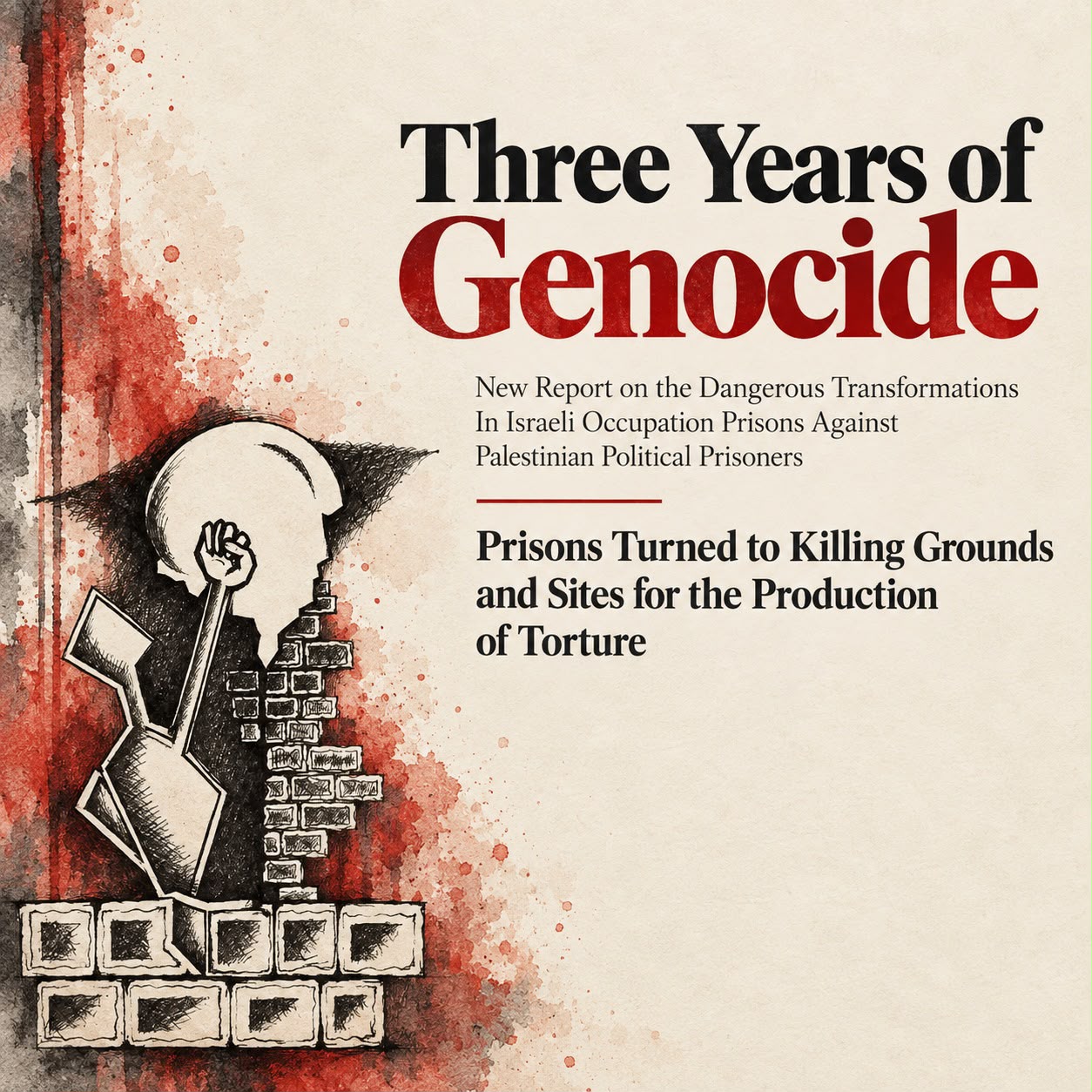
Three Years of Genocide: Dangerous and Ongoing Transformations in the Prisoners’ Issue Amid Occupation’s Ongoing Crime of Genocide
Palestinian Prisoners’ Institutions
October 6, 2026
Ramallah, occupied Palestine – The situation of Palestinian political prisoners held in Israeli occupation prisons has undergone unprecedented and dangerous transformations in scale and severity since the onset of the genocide in the occupied Gaza Strip. These developments are rooted in decades of systematic policies imposed by the occupation and entrenched through its prison system, with the support of its allies.
This paper, part of the ongoing documentation work of specialized Palestinian prisoners’ institutions, examines the most significant transformations in the prisoners’ cause through three areas: documented arrests; the number of prisoners and detainees held in occupation prisons and camps; and the principal crimes and policies of the prison system.
The genocide cannot be separated from the decades that preceded it. Mass and arbitrary incarceration has long been a central instrument of the settler-colonial project, used to break Palestinians physically and psychologically and impose control through increasingly violent and dehumanizing means. The enactment of the law providing for the execution of Palestinian political prisoners in March 2026 marked a culmination of this trajectory and a grave threat to the very existence of the Palestinian people.
Since the genocide began, the occupation’s treatment of prisoners and detainees has escalated beyond anything previously documented by the prisoners’ movement and relevant institutions. More than 100 Palestinian political prisoners have been killed or have died in the occupation’s prison system since October 2023; only 92 identities have been disclosed by the occupation authorities, in some cases months or years after their deaths. The bodies of dozens more remain withheld, with no information provided about their whereabouts, leaving families without answers.
These practices form part of enforced disappearance, a defining feature of this period and an independent violation of international humanitarian law. They also deny prisoners and their families their most basic rights to know their fate and access information about their whereabouts and conditions.
Arrest is no longer used merely to deprive Palestinians of liberty; it is used to target their very existence. Among the principal policies employed against Palestinian political prisoners are:
· Systematic torture, carried out in a structural and escalating manner.
· Starvation and systematic deprivation of food and water.
· Denial of medical treatment, which has turned the diseases and epidemics spreading throughout the prisons into lethal weapons.
· Sexual assaults, including rape, used as a tool to destroy the detainees’ dignity.
· Collective assaults involving rubber-coated bullets, electric-shock devices, batons, gas and sound grenades, as well as police dogs accompanying the repression forces in attacking detainees.
· Both direct and indirect policies of murder of detainees.
These policies have been continuously documented through testimonies gathered during lawyers’ visits, as well as testimonies from released prisoners, alongside periodic reports issued by prisoners’ institutions and local and international human rights organizations.
Documented Arrest Figures Since Start of Genocide
Approximately 26,000 arrests have been recorded in the occupied West Bank and occupied Jerusalem since the start of the genocide in October 2023, including over 800 women and 2,000 children. The arrests have not spared the elderly, sick, journalists, human rights workers, and other segments of Palestinian society. This figure excludes the thousands of arrests carried out in the Gaza Strip, which cannot accurately be documented due to the occupation’s ongoing genocide there, as well as disrupted information, isolation and information blackouts, and enforced disappearances, ill-treatment, and harsh detention conditions.
The genocide has marked a major escalation in the longstanding policy of arrest and persecution, with detention used as a tool of collective reprisal and subjugation. Arrests are accompanied by raids, searches, widespread vandalism and destruction to property and belongings, violent interrogations, and detention without adequate legal safeguards, with severe psychological, social, and economic consequences for detainees and their families. Mass and repeated arrests also disrupt daily life, sever family ties, and extend the impact of detention from individuals to their wider communities.
Inside prisons, interrogation centers, and camps, detainees face isolation, deprivation of basic rights, ill-treatment, and physical and psychological assaults, as documented through hundreds of testimonies and affidavits. The scale of these violations reflects an organized policy of collective targeting aimed at undermining Palestinian society and its ability to endure, hitting its social fabric and imposing fear and insecurity.
The figures presented here reflect only the minimum documented total. Hundreds of detainees from Gaza remain subject to enforced disappearance, with human rights organizations and the International Committee of the Red Cross (ICRC) denied access to them and information withheld about their detention conditions and fate. The actual scale of crimes committed in prisons and camps is therefore significantly greater than the figures documented here. The figures also do not include the hundreds, if not thousands, of Palestinians who are held for hours at a time in violent “field” interrogations carried out at the location of their detention.
Breakdown of Palestinian Political Prisoner Figures as of October 2026
Approximately 9,300 Palestinians held in Israeli occupation prisons, with close to half of them (49% or 4,520 people) held without trial or charge.
· 118 prisoners serving life sentences.
· 91 female prisoners.
· 350 children.
· 3,101 ‘administrative detainees’ – those abducted from the occupied West Bank and are held without trial or charge.
· 1,419 ‘unlawful combatants’ – those abducted from the occupied Gaza Strip and held without trial or charge - in addition to some detainees from Syria and Lebanon.
Martyred Palestinian Prisoners:
· Since the Israeli occupation of the West Bank and Gaza Strip in 1967, the number of identified Palestinians who were martyred in detention has reached 329 people.
· Following the genocide, 92 identified prisoners have been martyred in detention, though the figure of those killed is higher.
· Dozens of martyred detainees from occupied Gaza remain subject to enforced disappearance.
· The occupation continues to withhold the bodies of 100 Palestinian prisoners who were martyred in detention, both before and after the genocide.
“Administrative Detention” and Perpetual Detention Without Charge or Trial
The sharp escalation in the arbitrary use of “administrative detention”—detention without charge or trial, justified by the occupation under the prextext of “secret evidence”—has been one of the most prominent features of the escalation since the start of the genocide. Currently, ‘administrative detainees’ account for more than 33% of the total number of prisoners.
Occupation authorities have used it on a broad and historically unprecedented scale, detaining people without clear charges, access to the evidence against them, or a genuine opportunity to prepare a defense or challenge their detention. A measure intended to be exceptional and limited has thus become a permanent tool of control and reprisal. Repeated extensions without a clear end date leave detainees and their families in perpetual uncertainty, deny them knowledge of their legal fate, and undermine their rights to liberty, security of person, and effective judicial review.
Occupation authorities use ‘administrative detention’ for collective reprisal, control and surveillance, and to re-arrest previously released prisoners and prolong their detention without specific charges or a trial meeting basic standards of justice. The majority of ‘administrative detainees’ are former prisoners who have spent years in occupation prisons, much of that time under repeated administrative detention. This reflects an institutional pattern of re-detention that extends its impact to families and communities, turning release into a temporary status that can be revoked at any time.
The policy targets civilians, children, women, older persons, workers, and former prisoners. Documentation must therefore go beyond arrest figures to record detainees’ identities, places and conditions of detention, interrogation methods, detention periods, health and legal status, as well as torture, ill-treatment, or enforced disappearance—creating a comprehensive human rights record for accountability and legal proceedings.
Law to Execute Palestinian Detainees: Prisons as Killing Grounds and Sites for the Production of Torture
The law providing for the execution of Palestinian political prisoners, alongside the law concerning the trial of detainees from Gaza, is not merely a new “punitive” measure. It represents the culmination of decades of colonial and discriminatory practices targeting the Palestinian people and provides a legislative framework for systematic killing, intertwined with torture and broader colonial policies.
March 30, 2026 marked a dangerous turning point, when occupation authorities enacted the law providing for the execution of Palestinian political prisoners. Its significance lies in moving killing into the realm of official policy protected by legislation: granting military courts and prosecutors the power to impose death sentences turns courtrooms into potential sites of execution.
The law also opens the way to the targeted killing of Palestinian political leaders and cadres under the pretext of “security,” placing any Palestinian who resists the occupation or refuses to submit to its system at risk of execution by judicial order. Its threat therefore extends beyond those sentenced, functioning as a weapon of intimidation against Palestinians as a whole.
The law reflects a broader system of structural discrimination in which legislation is used to target the Palestinian national identity and perpetuate control through coercion. It treats the Palestinian prisoner as an object of control and killing rather than a participant in a struggle for freedom, and uses the death penalty to advance a policy of force while suppressing demands for justice and independence, reinforcing the apartheid system and legitimizing crimes against humanity.
“Incitement”: The Ready-Made Charge for All Palestinians
The use of “incitement” as a basis for arrest has expanded beyond specific content or conduct into a tool of control and surveillance, imposing vague and shifting limits on what Palestinians can say, publish, or express. Broad and loose interpretations of “incitement” widen the scope of prosecutable speech and conduct, making the fear of arrest itself a means of controlling behavior.
The policy operates preemptively, reshaping how Palestinians communicate and participate in public life. A post, word, image, political position, or personal account may be interpreted as “incitement,” embedding fear in everyday communication and driving self-censorship. Public expression becomes increasingly risky, weakening the ability to debate, document, testify, and express political and social positions.
The expanding charge also shifts control from physical acts to speech and narrative itself—including how Palestinians describe their reality, the occupation, and the violations they experience. It therefore reaches beyond preventing specific acts to constraining their ability to name, describe, and share their experiences, making control of language and discourse part of the broader control of the public sphere and production of narrative.
This policy reaches across society, including women, children, older persons, the sick, and pregnant women, creating a climate in which avoiding prosecution may depend on remaining silent. Its impact extends far beyond those arrested: under the threat of arrest, many others learn when to speak, what to say, and what to delete, conceal, or remain silent about. “Incitement” thus functions not only as a charge, but as a mechanism for governing through fear, restricting public expression, and producing compliance through self-censorship.
Message from Palestinian Prisoners’ Institutions to the International Human Rights System
For three years, Israeli occupation policies targeting every aspect of Palestinian life have intensified an entrenched system of colonial and settler-colonial control, reaching unprecedented levels during the ongoing genocide. The consequences extend beyond the crimes themselves to the international system meant to protect victims, enforce international law, and ensure accountability.
The institutions warn that this system is being steadily hollowed out: accountability mechanisms are obstructed, international bodies are denied access to victims, and monitoring and human rights organizations face restrictions. This entrenches a reality in which international decisions and rules are unable to translate into effective measures to protect people and hold perpetrators accountable. In this context, the continuation and escalation of these crimes despite the accumulation of evidence, testimonies, appeals, and international legal decisions raises deeper questions about the meaning of maintaining a legal and human rights system without the mechanisms capable of enforcing it.
Israeli occupation prisons are a central part of this system. Arbitrary detention, isolation, torture and ill-treatment, and deprivation of basic rights operate within closed environments designed to exert physical, psychological, and national control over Palestinians. Prisons therefore cannot be separated from the broader context of genocide; they are one of the mechanisms through which violence and control are reproduced, while access to victims and independent oversight remain severely restricted.
The testimonies and affidavits collected by prisoners’ institutions and human rights organizations over the past three years provide critical evidence of these violations and of the international system’s response—and its failures.
The International Committee of the Red Cross (ICRC) has a fundamental mandate to protect prisoners and detainees, monitor their conditions, and access them. Yet occupation authorities continue to prevent the ICRC from visiting Palestinian prisoners despite sustained contacts and meetings and an Israeli Supreme Court ruling that found the continued denial of visits unlawful. Restricting the ICRC’s access undermines independent monitoring and, more fundamentally, obstructs the ability of an independent international body to see victims, hear from them, verify their conditions, and report what is being done to them. When access to victims is blocked, both protection and accountability are weakened, with the detainees more vulnerable than ever.
What is happening in Palestine is a test not only of the international community’s response to Palestinians, but of whether international law can still protect human dignity, prohibit torture, protect prisoners and detainees, and hold perpetrators accountable. Allowing these violations to continue risks normalizing the erosion of international rules and making them repeatable elsewhere.
Key Demands
· Implement the ICJ advisory opinion immediately: End the unlawful colonial occupation and fully dismantle its settlement structures.
· Dismantle the discriminatory military justice system used to legitimize repression and collective punishment.
· Immediately, comprehensively, and unconditionally release all Palestinian prisoners and detainees, without political conditions or restrictions.
· Halt and abolish the use of the execution law against Palestinians: prohibit death sentences and prevent military or civilian courts from imposing them on a discriminatory basis.
· Take decisive diplomatic and legal action to prevent executions and hold those responsible for violations of the right to life accountable.
· Recognize the protection of Palestinian prisoners and detainees as an international responsibility, not an internal matter or one subject to retaliatory policy.
· Restore international protection and accountability: The protection of Palestinians and accountability for perpetrators are a test of whether international law remains an effective system for protecting peoples, rather than principles proclaimed while severe crimes continue.
(ENDS)